
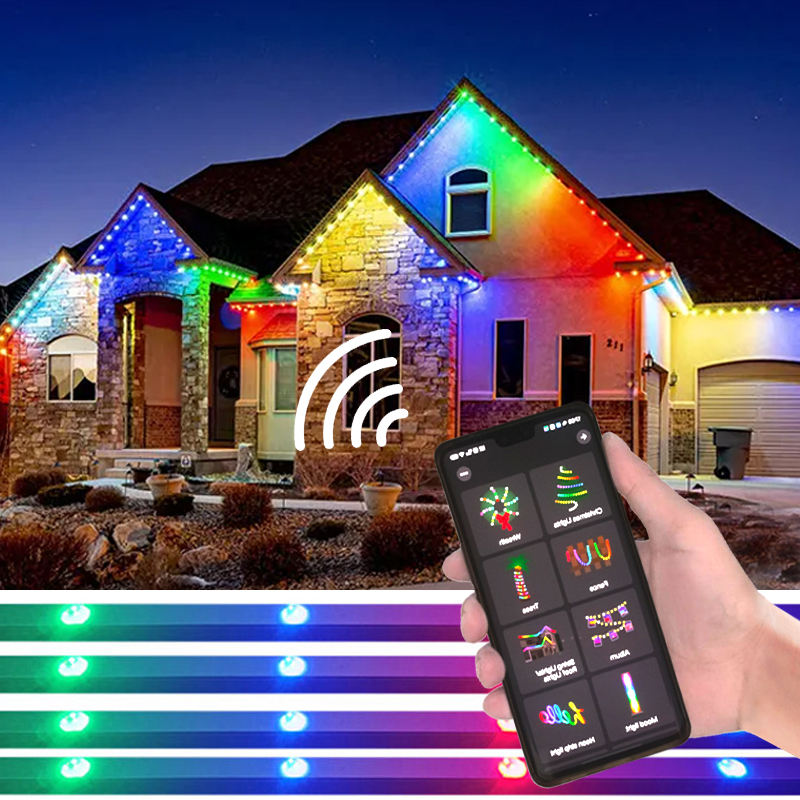
- Market growth: The permanent holiday lighting market in North America grew an estimated 40-60% from 2023 to 2025, driven by RGBW pixel technology and app-based controls
- Revenue model shift: Traditional seasonal lighting generates revenue 2 months/year; permanent lighting generates revenue year-round through installation, programming, and maintenance contracts
- Labor cost reduction: Permanent installation eliminates the annual “install + remove” cycle — a single install replaces 10+ seasonal visits over 5 years
- RGBW advantage: Dedicated white diode enables year-round architectural lighting (warm white for patios, pathways, and facades) — not just holiday colors
- App control: WiFi + Bluetooth + RF controllers allow homeowners to change colors, set schedules, and sync to music from their phone — no contractor visit needed
- Weatherproofing: IP65-IP68 rated systems withstand -20°C to 60°C, from Canadian freeze-thaw cycles to Arizona desert heat
- Property value impact: Real estate agents report permanent lighting systems as a selling feature that differentiates high-end properties
As we move into 2026, the landscape of the holiday lighting industry is undergoing a seismic shift. For years, professional installers relied on the “install and remove” seasonal model. While profitable, it came with significant labor overhead and safety risks twice a year. Today, the high-end residential and commercial market in the US and Canada is demanding Permanent Holiday Lighting — and the contractors who adapt early are capturing market share.
I’ve watched this shift happen from the manufacturing side. Three years ago, 90% of our pixel light orders were for traditional seasonal displays. Today, more than half are for permanent installations. The contractors placing those orders aren’t just buying lights — they’re transforming their business model. Here’s why.
What Is Permanent Holiday Lighting?
Permanent holiday lighting is a year-round lighting system installed along a property’s roofline, eaves, gutters, or architectural features. Unlike traditional string lights that go up in November and come down in January, permanent lighting stays in place permanently — controlled via a smartphone app to display different colors, patterns, and effects for any occasion.
The core technology is RGBW pixel lighting — individually addressable LED modules that can each display any color independently. Mounted inside aluminum channel tracks along the eave, the system is virtually invisible during the day. At night, it transforms the property with everything from warm white ambient lighting to animated holiday displays.
Why Contractors Are Switching: 5 Key Reasons
1. Year-Round Revenue, Not Just November-December
This is the #1 reason contractors give me for switching. Traditional holiday lighting has a revenue window of about 8-10 weeks per year. That means 80% of your annual lighting revenue is concentrated in less than 20% of the calendar. The rest of the year, your lighting crews are doing other work — or sitting idle.
Permanent lighting changes the math entirely. A single installation generates revenue at the time of install, but the system then creates ongoing opportunities:
- Programming services: Set up custom patterns for Valentine’s Day, St. Patrick’s Day, July 4th, Halloween, Thanksgiving, Christmas, and sports team colors
- Maintenance contracts: Annual inspection, connection resealing, and pixel replacement
- System upgrades: Adding zones, upgrading controllers, or expanding coverage
- Referral loop: Neighbors see the lights and ask who installed them — permanent systems are a 365-day marketing billboard
2. Eliminate the Seasonal Labor Scramble
Every holiday lighting contractor knows the November crunch. You’re racing to install dozens of jobs before Thanksgiving, working 14-hour days, hiring seasonal crew at premium wages, and praying for good weather. Then in January, you do it all again in reverse — tearing down in freezing temperatures, dealing with frostbite and ladder safety risks.
Permanent installation eliminates both crunches. You install once, typically during the slower spring or summer months when labor is available and weather is cooperative. No more November death marches. No more January teardowns in sub-zero temperatures. Your crew works year-round at a sustainable pace.
3. Higher Per-Job Margins
A traditional seasonal installation might generate $1,500-$3,000 per home — but it costs you $500-$1,000 in labor for install, plus another $300-$500 for teardown. Net margin: 40-50%.
A permanent pixel lighting installation typically runs $4,000-$12,000+ per home depending on linear footage and pixel density. Your material cost is higher, but the installation labor is a one-time expense — no annual teardown. Net margin on the initial install: 50-60%. And the recurring maintenance revenue adds another $200-$500 per year per property at nearly 80% margin.
| Metric | Traditional Seasonal | Permanent Pixel |
|---|---|---|
| Per-job revenue | $1,500-$3,000 | $4,000-$12,000+ |
| Annual labor (per property) | $800-$1,500 (install + teardown) | $0 (one-time install) |
| Recurring revenue | Same install fee each year | $200-$500/yr maintenance |
| 5-year total per property | $7,500-$15,000 | $5,000-$14,500 + referrals |
| Margin profile | 40-50%, labor-intensive | 50-60%, less recurring labor |
4. Curb Appeal and Property Value
Modern LED track systems are virtually invisible during the day — the aluminum channels blend with the eave, and the pixel modules sit flush. At night, the system transforms the property with architectural lighting that looks like a premium built-in feature, not a seasonal add-on.
Real estate agents in high-end markets are starting to list permanent lighting as a property feature — similar to a built-in pool or outdoor kitchen. For homeowners, this means the system adds tangible value to the property, not just aesthetic enjoyment. For contractors, this makes the upsell easier: you’re not selling “Christmas lights,” you’re selling a permanent property enhancement.
5. App Control = Happy Clients, Fewer Service Calls
The WiFi + Bluetooth + RF controllers on modern permanent lighting systems let homeowners control everything from their phone. They can change colors for different holidays, set daily schedules (warm white at sunset, off at midnight), and even sync lights to music for parties. This self-service capability means fewer “can you come change the colors” service calls — the client handles it themselves through the app.
The Technology Behind the Shift
Several technology advances made permanent lighting viable in 2026 when it wasn’t five years ago:
RGBW Pixel Technology
The shift from RGB to RGBW was the game-changer. RGB could only do holiday colors — the “white” was a blue-tinted afterthought. RGBW’s dedicated white diode means the same system that does Christmas red-and-green in December provides elegant warm white architectural lighting in July. This dual-use capability is what makes year-round installation worthwhile.
IP65+ Weatherproofing
Early pixel lights weren’t built for permanent outdoor exposure. Water ingress, UV degradation, and thermal cycling killed them within a year or two. Today’s systems like our replaceable RGBW permanent lights feature IP65-rated housings with UV-resistant materials, rated for -20°C to 60°C operation. They’re built to last 5-10+ years of continuous outdoor exposure.
Replaceable Pixel Modules
The biggest maintenance concern with permanent lighting has always been: “What happens when a pixel burns out?” Older systems required unwiring and replacing entire runs. Today’s replaceable RGBW permanent lights allow individual pixel modules to be snapped out and replaced in seconds — no rewiring, no climbing the ladder with a soldering iron.
How to Position Permanent Lighting to Your Clients
If you’re adding permanent lighting to your service lineup, here’s how I’ve seen successful contractors position it:
- Don’t call them “Christmas lights”: Call it “permanent architectural lighting” or “smart outdoor lighting system.” You’re selling a property enhancement, not a seasonal decoration
- Lead with the everyday value: Show the warm white architectural mode first — that’s what clients will use 300+ days per year. Holiday colors are the bonus, not the pitch
- Bundle with existing services: If you do landscaping, hardscaping, or outdoor living, permanent lighting is a natural upsell. “While we’re doing your patio, want to add permanent lighting to the eave?”
- Offer financing: A $6,000 system is easier to sell at $125/month than $6,000 upfront. Many contractors partner with financing platforms
- Show a demo: Nothing sells permanent lighting like seeing it in person. Install one at your own house or office, or carry a portable demo board
FAQ: Contractors Switching to Permanent Lighting
Q: Do I need special training to install permanent pixel lights?
A: If you can install traditional C7/C9 string lights, you can install permanent pixel lights. The main differences are mounting (aluminum channel vs. clips) and wiring (data line + power injection). Our roofline installation guide and wiring guide cover everything you need. Most contractors pick it up within one or two installations.
Q: What’s the typical ROI for a contractor adding permanent lighting?
A: Most contractors recover their initial investment (sample kit + training + marketing) within 3-5 installations. After that, permanent lighting typically generates 2-3x the per-job revenue of traditional seasonal work, with less recurring labor. See our permanent vs traditional cost comparison for detailed numbers.
Q: Can I still offer traditional string lights alongside permanent lighting?
A: Absolutely — and you should. Many clients still want traditional C7/C9 for specific areas or budgets. The hybrid approach lets you serve every client tier. Read our C7 vs C9 guide for traditional lighting options.
Q: How do I handle warranties and pixel replacement?
A: Look for systems with individually replaceable pixel modules — if one fails, you swap it in 30 seconds without rewiring. At Andysom, we provide a 2-year warranty on pixel modules and offer replacement modules at wholesale pricing for contractors.
Q: What’s the minimum order to get started as a contractor?
A: Most permanent lighting manufacturers (including us) offer contractor pricing starting at 500-1000 pixels — enough for 2-3 average residential installations. Request a contractor quote with your project details for exact pricing.
Ready to Add Permanent Lighting to Your Services?
If you’re a contractor looking to add permanent pixel lighting to your service lineup, I’d love to help you get started. Send me your typical project sizes and target market, and I’ll put together a contractor pricing package including sample kits, installation guides, and marketing materials.
Email ban@andysom.com or reach out on WhatsApp. We ship from both China and Vietnam factories, so we can optimize your landed cost and lead time.
Zoya is the sales director at Andysom, a professional lighting manufacturer with 16 years of experience producing permanent pixel lights, commercial string lights, and landscape lighting for contractors and distributors worldwide.
Related Products
- 43x38mm Replaceable RGBW Permanent Lights – Addressable 120V IP65 eave light with WiFi/Bluetooth/RF
- 50mm Round RGBW Permanent Lights – 120V addressable eave light
- 120V High Voltage Eave Light – IP65 ETL certified roofline light
- IP68 12V UCS2904 RGBW LED Pixel Light – WiFi/Bluetooth programmable addressable
Related Articles